PEC contractor categories in Pakistan
PEC contractor categories in Pakistan classify construction firms by the maximum value of an engineering construction project they may undertake under their Pakistan Engineering Council (PEC) registration. These registration classes help contractors select appropriate licences, while project owners and procurement teams assess eligibility for construction tenders.
The category alone does not qualify a company for every contract. A valid licence, approved specialization codes, engineering personnel, and the particular tender’s qualification criteria must also be checked.
What is PEC contractor registration?
PEC contractor registration is the Pakistan Engineering Council’s licensing framework for constructor firms carrying out engineering construction works. Registration identifies the firm’s approved category, construction-cost ceiling and authorized disciplines. For a road, bridge, building or drainage contract, the procurement team should check these particulars alongside the firm’s actual experience and technical capacity.
PEC contractor categories and project limits in Pakistan
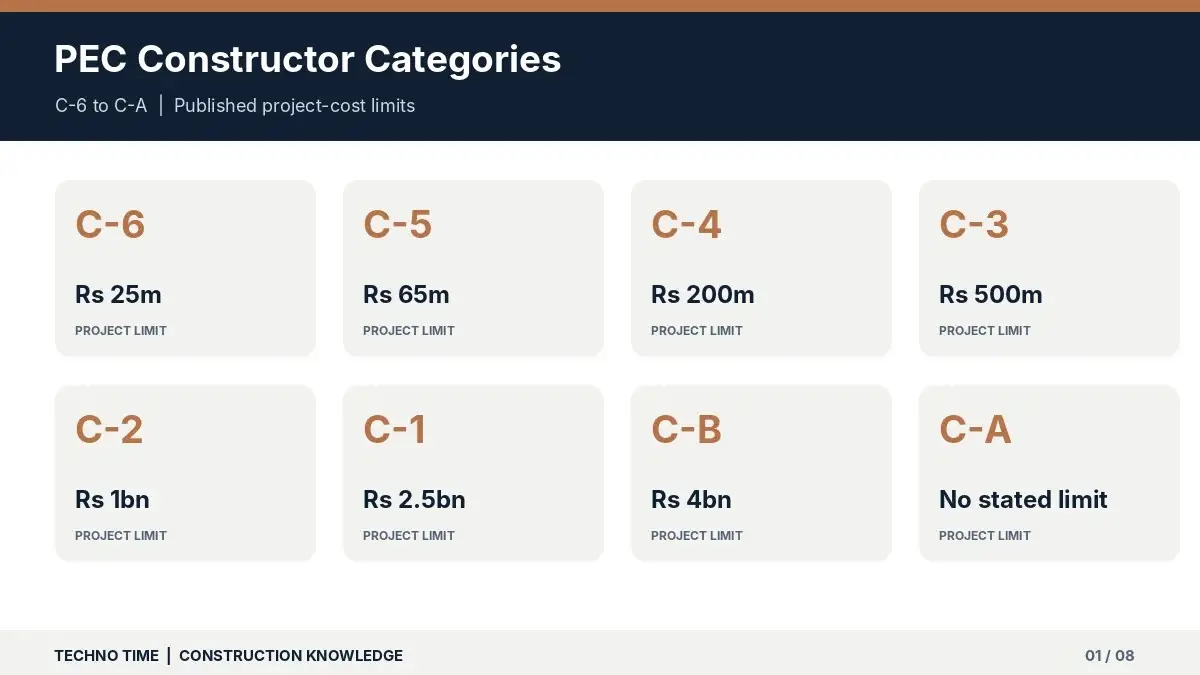
PEC publishes eight principal local constructor classes, from C-6 to C-A. The project ceilings in the policy amended through 28 June 2024 are as follows. One crore equals ten million Pakistani rupees.
| Category | Construction cost limit per project | Minimum PCPs |
|---|---|---|
| C-A | No stated limit | 200 |
| C-B | Rs. 4,000 million (400 crore) | 120 |
| C-1 | Rs. 2,500 million (250 crore) | 90 |
| C-2 | Rs. 1,000 million (100 crore) | 35 |
| C-3 | Rs. 500 million (50 crore) | 20 |
| C-4 | Rs. 200 million (20 crore) | 15 |
| C-5 | Rs. 65 million (6.5 crore) | 5 |
| C-6 | Rs. 25 million (2.5 crore) | 5 |
Source: PEC Registration Policy 2017 as amended through June 2024. Verify the most recent PEC notifications and individual licence conditions before bidding.
C-6 and C-5: entry-level and small projects
C-6 permits projects up to Rs. 25 million, while C-5 extends the ceiling to Rs. 65 million. Both have a published baseline requirement of five Professional Credit Points (PCPs) and one Registered Engineer, subject to the relevant registration route. A company planning projects above the C-6 ceiling should assess a suitable higher class before tendering.
C-4 and C-3: medium-scale work
C-4 covers projects up to Rs. 200 million with 15 PCPs, and C-3 covers projects up to Rs. 500 million with 20 PCPs. PEC specifies engineering staff composition requirements in addition to the credit total. Neither category automatically authorizes all types of civil engineering work.
C-2 and C-1: major construction contracts
C-2 has a Rs. 1 billion ceiling and a 35-PCP baseline. C-1 has a Rs. 2.5 billion ceiling and a 90-PCP baseline. These classes are relevant to higher-value contracts, where experience, staffing, financial records, specialization codes and tender requirements become especially important.
C-B and C-A: highest constructor classes
C-B permits projects up to Rs. 4 billion and requires a baseline of 120 PCPs. C-A has no stated construction-cost ceiling in PEC’s category table and requires 200 PCPs. No stated category ceiling does not mean unlimited technical eligibility; each tender can impose additional requirements.
What are Professional Credit Points and engineer requirements?
Professional Credit Points (PCPs) represent a measure within PEC’s engineering professional-capacity framework. Higher registration categories generally require more credits and a specified complement of Registered Engineers (REs), Professional Engineers (PEs) and trainee engineers.
For example, PEC’s published requirements for C-1 include two PEs with at least ten years’ experience each and the required additional engineering personnel. C-B and C-A call for more experienced PEs and additional staffing. Engineer-owned firms may fall under distinct policy provisions. Verify individual personnel, employment and professional-registration details through PEC.
The PEC PCP calculator can help applicants review the applicable professional-credit requirement.
PEC categories versus specialization codes
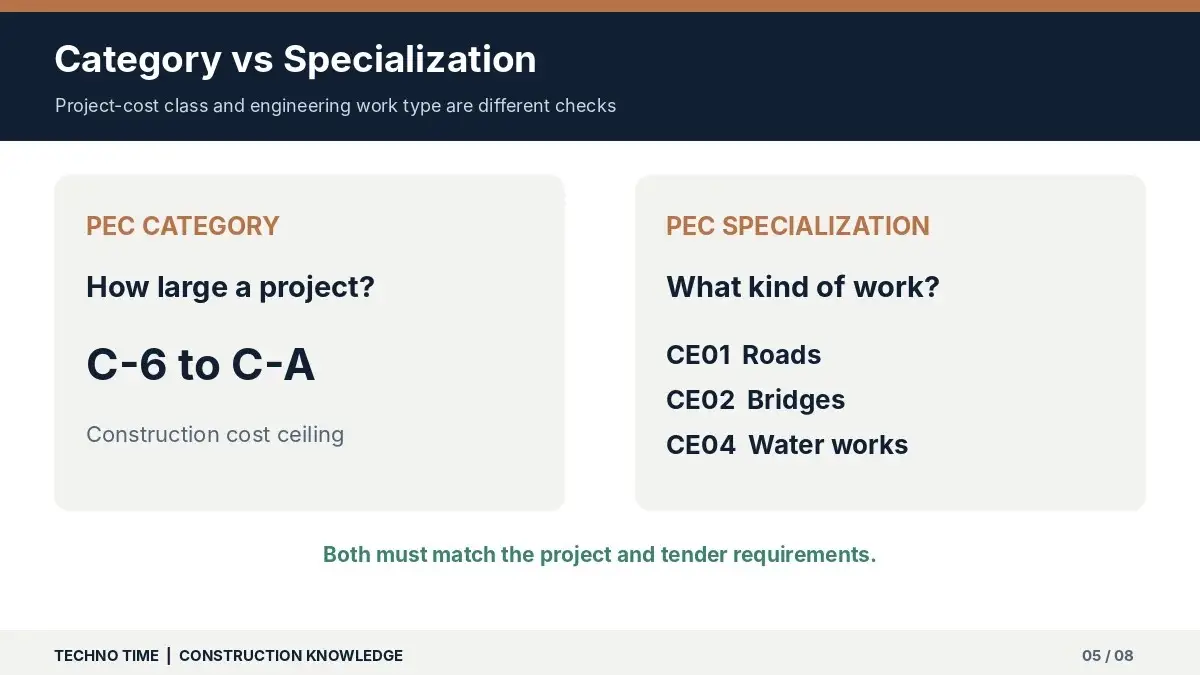
A PEC category defines the project’s permissible construction-cost ceiling; a specialization code identifies the engineering field in which a firm is authorized. Both matter. A C-2 firm, for example, should not assume that its category permits every bridge, highway or water-infrastructure contract.
PEC’s specialization listings include CE01 for roads, pavements and associated drainage, CE02 for bridge structures and piling, CE04 for dams and water-related structures, and CE09 for sewerage and water supply. Each code may contain further conditions or subcategories. Refer to the official PEC specialization list and the actual licence.
See Techno TIME’s roads and highways and bridge and flyover construction service pages for examples of the distinct engineering disciplines clients may need to evaluate.
How to register a construction firm with PEC
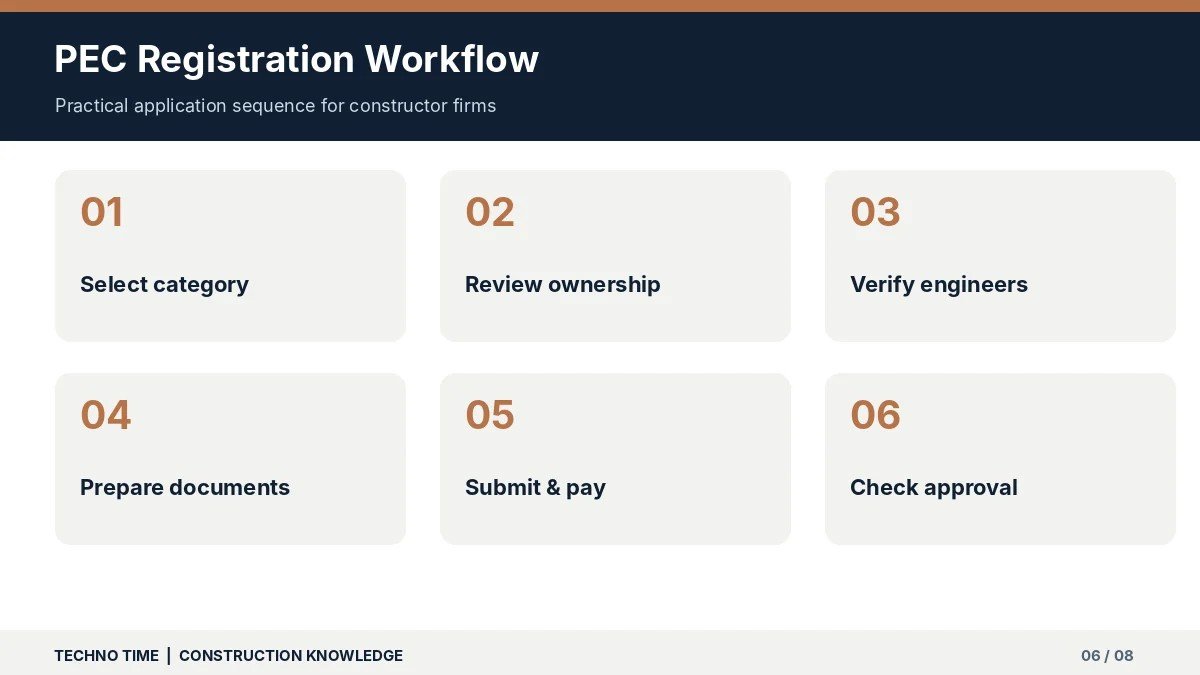
- Choose a category: compare anticipated contract values with the published category ceilings.
- Check the registration route: distinguish engineer-owned from other permitted company structures.
- Arrange qualified staff: confirm engineering registrations, experience, PCPs and specialization eligibility.
- Prepare company records: provide the legal, tax, financial, personnel, machinery and organizational documents required for the application.
- Apply through PEC: follow the Constructor/Operator portal instructions and pay the applicable fee.
- Complete verification: respond to deficiencies and check the issued licence’s category, codes and validity.
PEC contractor registration fees
PEC’s published standard fees for Pakistani constructor firms are C-6 Rs. 15,000; C-5 Rs. 30,000; C-4 Rs. 45,000; C-3 Rs. 75,000; C-2 Rs. 125,000; C-1 Rs. 150,000; C-B Rs. 250,000; and C-A Rs. 400,000. Different renewal, engineer-owned or upgrade arrangements may apply. Confirm the live applicable fee with PEC’s official fee schedule before paying.
Can a contractor upgrade its PEC category?
Category upgradation is PEC’s formal approval to move an eligible firm into a higher constructor class. The published guidance considers construction performance, qualifying work history, engineering resources, applicable fees and the registration route. Some performance-based routes consider work awarded or executed during the preceding three years and specified completion thresholds. These requirements must be checked against the latest policy and the firm’s circumstances.
For example, a C-5 contractor considering a Rs. 120 million project cannot rely on its existing Rs. 65 million ceiling. The firm should review whether it qualifies for C-4 registration before pursuing a tender that requires the higher class.
PEC registration and government tender eligibility
Tender eligibility depends on the procuring agency’s bidding documents as well as the firm’s licence. Contractors should examine the category ceiling, specialization codes, valid registration, comparable experience, financial requirements, equipment and staff. Federal procurement requirements under PPRA are distinct from PEC’s engineering registration framework; compliance with one does not replace compliance with the other.
Before accepting a contractor’s claimed credentials, verify its licence number, legal name, category, expiry and approved codes using the PEC verification portal. Clients should also independently assess project management, safety, quality control and delivery experience.
Frequently asked questions
Which is the highest PEC contractor category?
C-A is the highest listed local constructor category and has no stated project-cost ceiling in PEC’s published category table.
What is the PEC C-6 project limit?
Rs. 25 million, equivalent to Rs. 2.5 crore, under the cited constructor policy.
What is the difference between C-3 and C-2?
C-3 permits projects up to Rs. 500 million and has a 20-PCP baseline; C-2 permits up to Rs. 1 billion with a 35-PCP baseline. Other staffing and licensing conditions apply.
Does a higher PEC class guarantee tender eligibility?
No. Specialization, licence validity, past experience, equipment, finances and tender-specific criteria may also determine eligibility.
Can a PEC licence be upgraded?
Yes, after PEC reviews applicable upgradation requirements and approves the category change.
Final guidance for contractors and project owners
PEC contractor categories are a useful starting point for construction tender compliance, but the category should be read together with specialization codes, personnel requirements and actual qualifications. Construction companies should maintain accurate registration records, while project owners should verify credentials before awarding work.
For infrastructure-related project enquiries, explore Techno TIME’s civil engineering services or contact the team.
Official references
- PEC Registration Policy 2017, amended through June 2024
- PEC registration document requirements
- PEC specialization codes
Information reflects the cited PEC policy. Verify current amendments and tender terms before applying or bidding.