
Concrete quality testing in construction is the combination of fresh-concrete checks, specimen strength testing, documented sampling, and site inspection that helps engineers verify whether a concrete pour conforms to the approved mix design and project specifications. For construction projects in Pakistan, the three terms frequently encountered are the slump test, concrete cube strength test, and pre-pour or on-site inspection.
These checks answer different questions. A slump measurement describes the consistency of fresh concrete; a laboratory compression test measures the strength of a prepared specimen at a stated age; a site inspection establishes whether the reinforcement, formwork, placement, compaction, and curing arrangements meet the approved requirements. Passing one check does not replace the other two.
This guide explains what each test can and cannot establish, how to calculate cube strength, how seven-day and 28-day reports should be interpreted, what to record during pouring, and how to respond to suspect results. It is intended for contractors, site engineers, quantity surveyors, project managers, students, and owners reviewing construction quality-control records.
Technical note: Always follow the standard editions, approved drawings, engineer’s instructions, and project-specific acceptance criteria stated in the contract. ASTM/ACI cylinder-based acceptance systems and BS/EN cube-based testing systems are not interchangeable without an approved design and assessment basis.
What is concrete quality testing?
Concrete quality assurance (QA) is the planned system of specifications, approvals, method statements and inspections. Quality control (QC) is the sampling, checking, testing and recording performed to verify compliance. A sound project needs both: tests without traceable inspection records do not establish exactly where a material was placed, while visual inspection alone cannot demonstrate the specimen’s compressive strength.
Concrete testing ordinarily occurs at three stages:
- Before delivery and placement: verify the approved mix, materials, batch information, equipment, formwork, reinforcement and pour permit.
- While concrete is fresh: check delivery details, workability or consistency, temperature and other specified properties; take representative specimens and observe placement.
- After placement: protect and cure the concrete, test samples at the specified ages and review results against project acceptance rules.
| Activity | What it checks | What it does not prove |
|---|---|---|
| Slump test | Fresh-concrete consistency and changes in workability | 28-day compressive strength |
| Cube or cylinder strength test | Specimen compressive strength at a stated age | Correct rebar cover, compaction, or curing of the entire structure |
| Site inspection | Preparedness, placement, reinforcement, records, curing and workmanship | The laboratory result of the mix on its own |
Concrete slump test: purpose, procedure and limitations
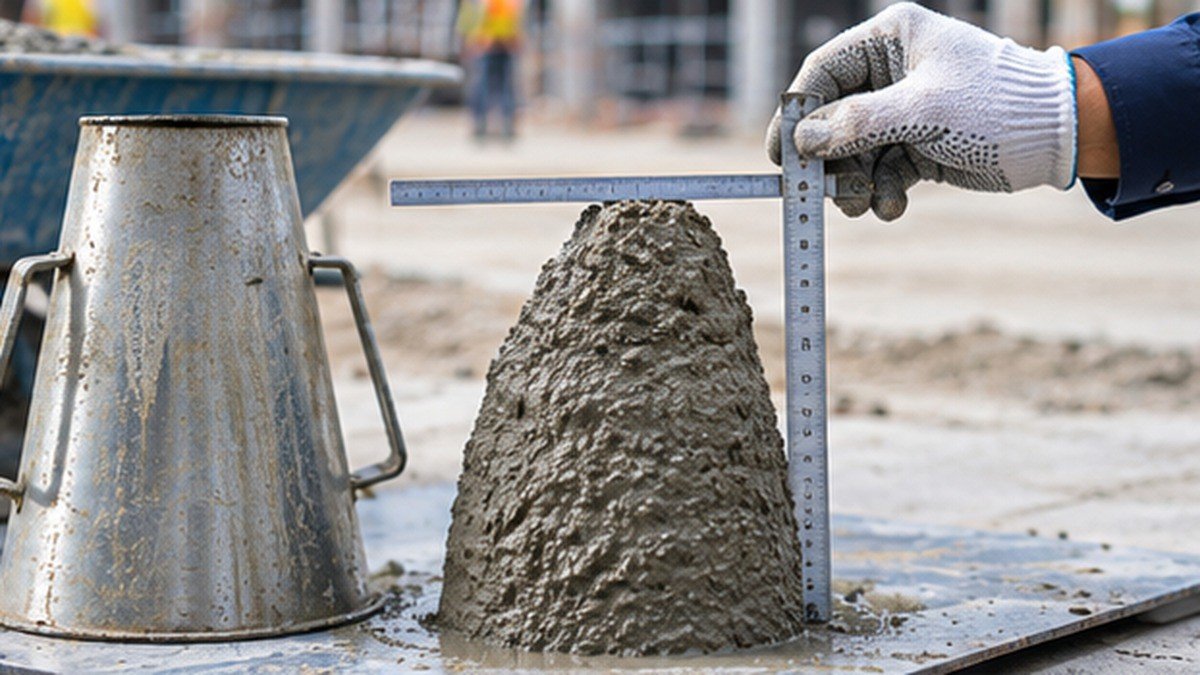
The slump test measures the drop in height of a cone-shaped sample after the mould is lifted. It provides a practical indication of the consistency of fresh concrete and helps identify significant changes between loads. It is not a direct compressive-strength test. The ASTM standard cautions that under field conditions, slump and strength do not have a consistent relationship.
Relevant methods include ASTM C143/C143M and BS EN 12350-2:2019. The applicable method should be established before testing; do not mix details from different standards.

Typical slump-test equipment
A properly specified slump cone or mould, flat nonabsorbent base, tamping rod, ruler or measuring scale, sampling receptacle, and cleaning equipment are needed. Equipment condition matters: a warped cone, unstable surface or careless lifting can invalidate a result.
How is a slump test performed?
- Collect a representative sample from the concrete delivery using the project-approved sampling standard, rather than selecting only an unusually wet or dry portion.
- Prepare and secure the mould on a clean, level, nonabsorbent base.
- Fill and compact the concrete according to the selected standard; for common ASTM/EN cone methods, the cone is filled in three layers with prescribed rodding and levelling operations.
- Lift the mould vertically without twisting or side movement, within the procedure’s required timing.
- Measure the drop between the mould’s original height and the displaced concrete and record the result in millimetres, using the method’s prescribed measurement rule.
- Compare with the approved value or class and record the batch, location, time, tester and any corrective action.
Testing should be performed by trained personnel. The precise timings, aggregate-size limits, applicability range and reporting rules come from the standard used on the project.
What is an acceptable concrete slump?
There is no single universally acceptable slump for every structural element. The target depends on the approved mix, placing method, reinforcement congestion, pumping requirements, admixtures and tolerance stated in the contract. A pumpable mix or heavily reinforced section may need a different consistency from a relatively simple footing.
A very low or unusually high slump may signal a changed mixture, loss of workability, segregation risk or a testing problem. Do not add water at site to improve workability unless the approved mix and authorised procedure expressly permit it and the addition is documented. Uncontrolled water addition can change the water-cementitious ratio and undermine intended performance.
True slump, shear slump and collapse
A true slump retains a broadly symmetrical mass after subsiding. A shear slump slides or shears on one side, while a collapse loses its form substantially. The applicable test standard governs whether the result is valid and whether repeat or alternative testing is required. Recording an invalid collapse as a normal numeric slump is misleading.
Concrete cube strength testing: how it works
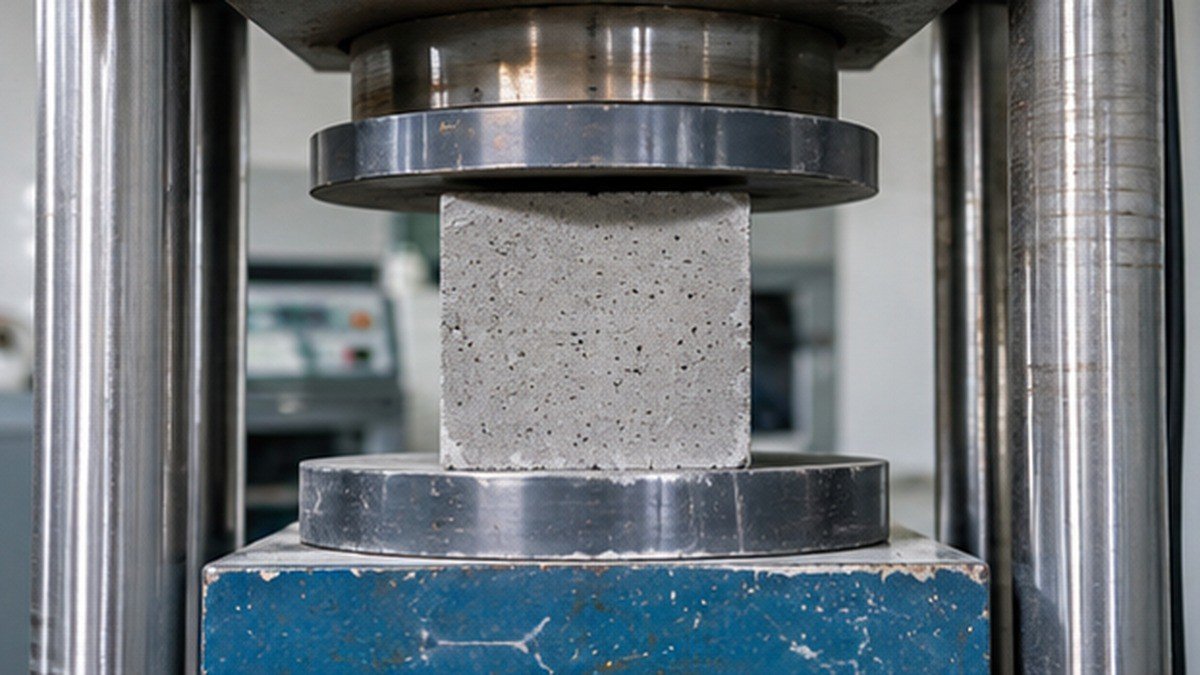
A concrete cube strength test determines the compressive resistance of a standardised hardened specimen. In projects specifying cube testing, specimens are sampled, moulded, labelled, cured and later loaded to failure in a calibrated compression testing machine. The result is the maximum load divided by the loaded area, usually reported in megapascals (MPa) or N/mm².
BS EN 12390-3:2019 addresses compressive-strength testing of hardened specimens, with specimen preparation and curing governed by the related EN series. For cylinder-based work, ASTM C39/C39M is a laboratory compression standard. Cylinder and cube results must not be treated as numerically equivalent simply because both are expressed in MPa.
Sampling, moulding and identifying cubes
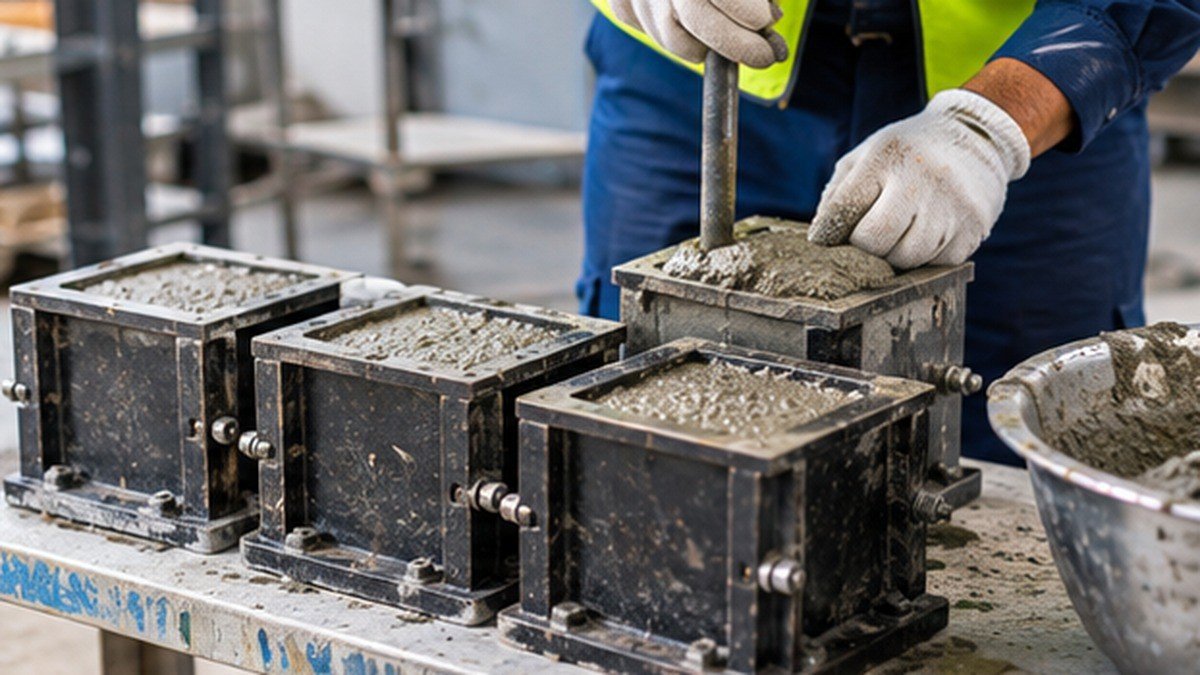
Samples must represent the concrete actually delivered and placed. Record a unique specimen code, mix designation, delivery ticket, batch or truck number, sampling time, concrete location, casting date, intended test age, and technician. Ensure the moulds are clean and the specimen preparation follows the approved standard. For example, a foundation pour may have separate cube sets from a column or slab poured on another day.
Concrete cube curing and handling
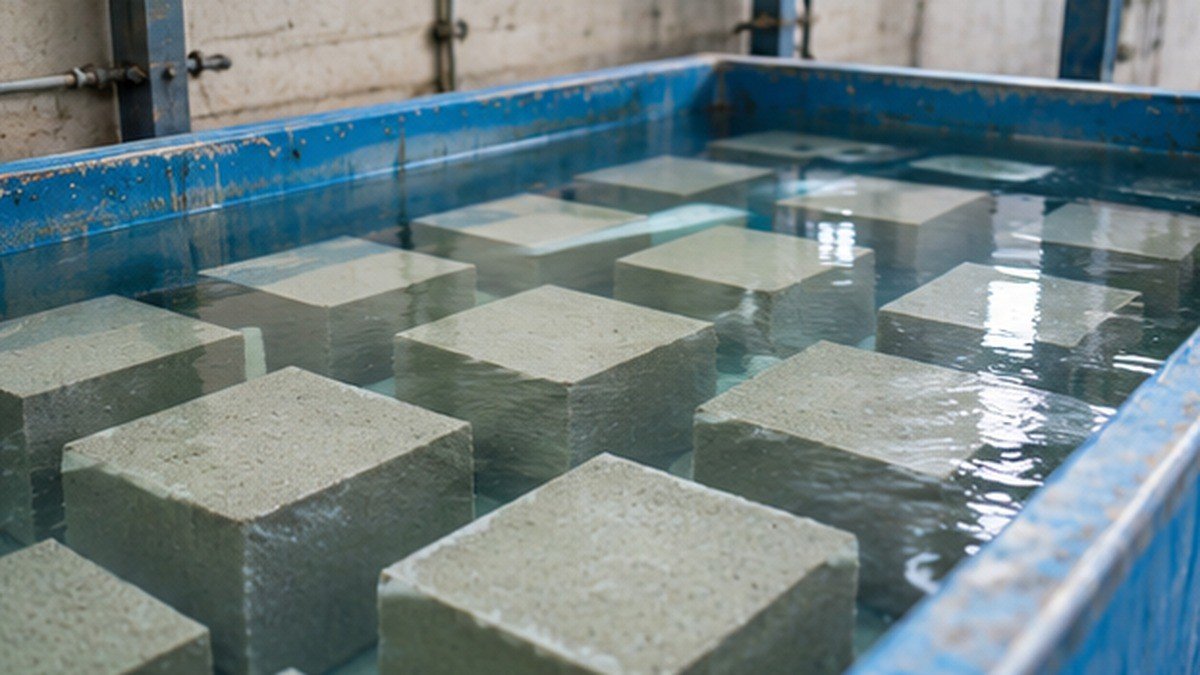
Fresh cubes should be protected during their initial period and then stored under the specified curing regime. Temperature, moisture, demoulding, transport and testing delays affect the observed strength. Do not leave specimens exposed to excessive sun or allow them to dry out and then assume a low result reflects only the mix.
The National Ready Mixed Concrete Association explains why standard curing is necessary for judging the supplied concrete’s strength potential. Where the approved method uses cubes, apply the corresponding specimen-making and curing standard instead of borrowing cylinder procedures.
How to calculate concrete compressive strength
The fundamental calculation is:
Compressive strength (N/mm² or MPa) = Maximum test load (N) ÷ Loaded face area (mm²).
For a hypothetical 150 × 150 mm cube with a maximum failure load of 675 kN:
- Load: 675 kN = 675,000 N
- Loaded area: 150 × 150 = 22,500 mm²
- Strength: 675,000 ÷ 22,500 = 30 N/mm² (30 MPa)
This is a calculation example, not a prescribed acceptance result. The laboratory must use the specimen’s actual dimensions and the applicable standard’s testing, calculation and reporting rules. A calibrated testing machine and correct positioning are essential.
7-day vs 28-day cube strength results
Seven-day results provide early evidence of strength development and may identify a potential problem before later test ages. Twenty-eight-day results are often the specified age for compliance, unless the project documents set another age or criterion. Some special mixes are assessed at different ages, such as 56 days.
There is no reliable universal rule that every seven-day specimen must achieve a fixed 65%, 70% or 75% of its 28-day strength. The proportion varies with cement type, supplementary cementitious materials, admixtures, temperature, curing and mix design. The American Concrete Institute explains that early-age tests are mainly useful for tracking strength gain, not normally the stated 28-day acceptance decision.
What if the cube strength result is low?
Do not automatically reject a structural element or ignore the result. First confirm the correct mix grade, specified age, sampling identification, cube dimensions, curing history, laboratory calibration, loading procedure, arithmetic and the governing acceptance method. Review related test sets and involve the responsible engineer.
Where necessary, the engineer may require additional records, investigation of in-place concrete, non-destructive testing as supporting information, or properly planned core sampling. Tests of cores and evaluation of structural adequacy require an approved procedure and qualified interpretation. Keep any hold points, non-conformance reports, and corrective actions documented.
Concrete site inspection before, during and after pouring
A passed slump test and satisfactory laboratory report do not replace the engineer’s observations of the actual placement. Concrete can be compliant on the delivery ticket and still fail to perform because of inadequate compaction, excessive drop, reinforcement displacement, honeycombing, poor joints or neglected curing.
Pre-pour inspection checklist
- Approved latest structural drawings, bar bending schedules and method statement available.
- Formwork levels, dimensions, stability, cleanliness and release agents checked.
- Reinforcement size, spacing, laps, anchorage, cover blocks, chairs and embedments verified.
- Openings, sleeves, waterstops, construction joints and cast-in items coordinated.
- Pour sequence, access, pump line, backup plan, lighting and manpower reviewed.
- Concrete grade, approved mix, supplier arrangements, test sampling plan and inspection hold points agreed.
- Safe working conditions, access, weather protection and curing materials ready.

Inspection during placement
Site staff should verify delivery tickets and authorised batching details; monitor changes in fresh concrete appearance and workability; ensure correct placing in lifts; observe vibrator use and compaction; prevent segregation and rebar displacement; and record placement location, start and end times, test results and any interruptions. Testing frequency must follow the contract or governing standard, not an arbitrary site rule.
Inspection after placement
Protect concrete from early drying, excessive heat or cooling, rain damage and impact. Start the specified curing method promptly. Examine exposed surfaces after stripping for cracks, honeycombing, cold joints, spalling, dimensional deviations and other defects, and route defects through the engineer’s approved repair procedure rather than covering them without a record.
Concrete quality-control records every project should maintain
| Record | Why it matters |
|---|---|
| Approved mix design and material approvals | Connects performance requirements to the authorised concrete mixture |
| Delivery tickets and pour register | Shows batch identification, volume, location and chronological placement |
| Slump / fresh-concrete test log | Tracks consistency against the approved specification |
| Cube sampling, casting and curing register | Provides traceability between placed concrete and specimen condition |
| Laboratory compression reports | Records age, strength, failure load and relevant observations |
| Pre-pour and post-pour checklists | Records engineer checks and workmanship issues |
| Non-conformance and corrective-action reports | Captures how deviations were investigated and resolved |
A simple, disciplined numbering convention, such as project–pour–sample–specimen, helps prevent the wrong test report from being attributed to a structural element. Link strength reports to the daily pour register and keep laboratory records in a retrievable format.
Common concrete testing mistakes and their consequences
- Assuming slump equals strength: workability and compressive strength are different properties.
- Sampling only the most convenient concrete: unrepresentative samples distort QC conclusions.
- Adding water without control: alters approved mixture assumptions and potentially durability.
- Using unclean or inaccurate moulds: changes specimen geometry and test reliability.
- Poor specimen curing: changes the measured strength independently of the delivered mix.
- Comparing cube results directly with cylinder criteria: ignores the testing system and specified basis.
- Applying a universal 7-day percentage: overinterprets early-age strength gain.
- Missing batch and location IDs: leaves a test result with weak traceability to the structure.
- Treating a low result as an automatic final verdict: bypasses engineering evaluation and contract requirements.
Concrete testing standards relevant to Pakistan projects
Construction contracts in Pakistan may reference Pakistani specifications, British/European standards, American ASTM/ACI provisions, or a defined combination. The correct choice must be explicit in the tender and approved quality plan. The table below is a guide to common references, not a substitute for their complete requirements.
| Purpose | Common standard family | Important distinction |
|---|---|---|
| Fresh concrete slump | ASTM C143/C143M or BS EN 12350-2 | Procedure, applicability and reporting follow the chosen method |
| Fresh concrete sampling | ASTM C172/C172M or BS EN 12350-1 | Sampling method and timing affect representativeness |
| Specimen making and curing | ASTM C31/C31M or BS EN 12390-2 | Shape, curing and laboratory procedures differ |
| Compressive strength | ASTM C39/C39M or BS EN 12390-3 | Cylinder and cube results require their own specified acceptance rules |
| Structural acceptance | Applicable code and project specification | One specimen result alone may not constitute the acceptance decision |
The ACI technical FAQ identifies how specimen geometry, sampling, preparation, curing, moisture condition and test-machine loading affect observed results. That is why a trustworthy laboratory test is a controlled process, not merely a number printed on a report.
How concrete QA supports cost control and project delivery
Correct testing and inspection reduce the likelihood of avoidable rework, disputes and latent defects. They also support a more defensible record of completed construction work. Quantity-based procurement and concrete quantities should remain consistent with the project documentation; for related guidance, read BOQ in Construction.
Concrete quality matters in bridge construction and foundation planning, industrial building projects, and road rehabilitation and reconstruction. In every case, quality records should match the structural and operational demands of the particular work.
Frequently asked questions
What is the main purpose of the concrete slump test?
It is a field indication of the fresh concrete’s consistency and helps monitor changes between deliveries. It does not directly establish compressive strength.
Is 28-day concrete cube strength always required?
Many specifications use 28-day results, but some mixes or contract documents specify a different test age. Follow the actual approved test programme.
What does a 30 MPa cube test result mean?
It indicates a calculated compressive strength of 30 N/mm² for that specimen under the specified testing method. Whether the batch is accepted depends on the applicable specification and assessment rules.
Are slump tests and cube tests enough for concrete quality assurance?
No. Representative sampling, correctly cured specimens, calibrated testing, pre-pour inspections, placing workmanship, curing and traceable documentation are all essential.
What should the contractor do if concrete strength is below the specified requirement?
Notify the responsible engineer, verify the test process and relevant records, and follow the project’s non-conformance and engineering evaluation procedure. Do not independently decide whether an affected structural element is safe.
Can cube results and cylinder results be compared directly?
No. Specimen geometry and test methods affect measured results. Any comparison or conversion must follow a documented, approved engineering basis rather than a universal assumption.
Final concrete quality inspection checklist
Before closing a concrete pour record, confirm that the approved mix, sampling log, slump or other fresh-concrete checks, cube IDs, laboratory results, pour location, inspection clearances, curing records and any outstanding non-conformance actions are traceable and complete. The responsible engineer should review and sign off the relevant evidence against the project’s acceptance requirements.
At Techno TIME Construction Pvt Ltd., our construction and civil engineering work is guided by the importance of planning, supervision, quality records and reliable execution. For construction enquiries and project coordination, contact Techno TIME with your project location, drawings and scope.
Image disclosure: the photographs in this guide are AI-generated educational illustrations, not documentation of a particular Techno TIME construction project or laboratory test.