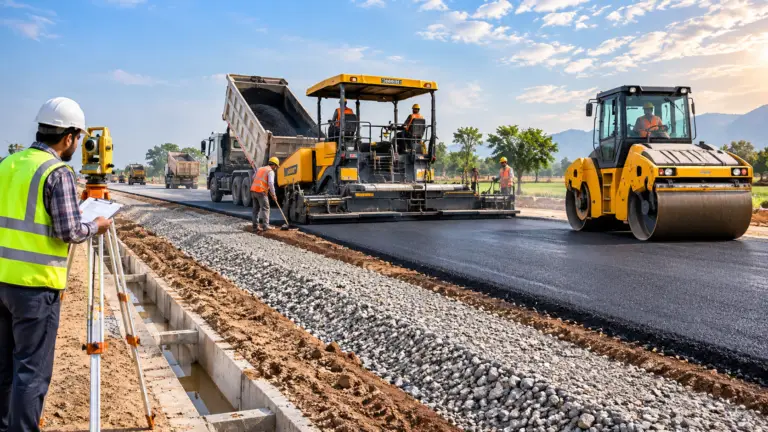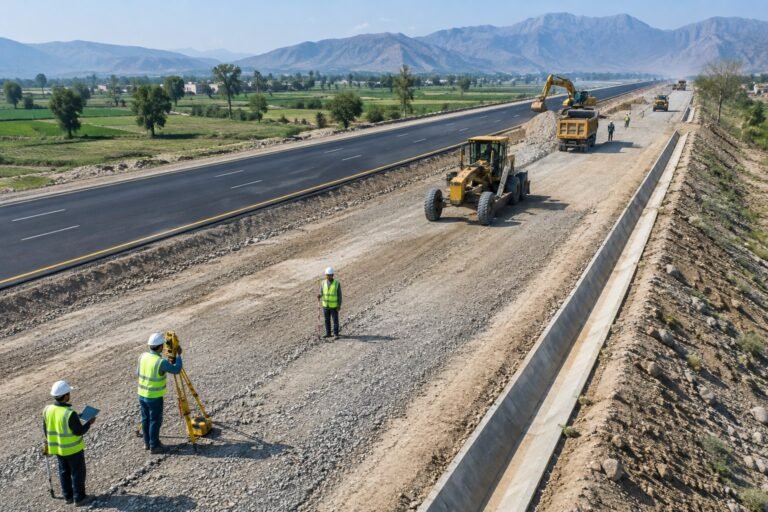
Road rehabilitation vs reconstruction is an important decision for road authorities, infrastructure developers, contractors, and project owners. Road rehabilitation improves an existing pavement and restores its performance, while road reconstruction replaces some or all of a failed pavement structure.
Rehabilitation is generally more cost-effective when the existing pavement foundation remains serviceable. Reconstruction becomes more appropriate when structural deterioration is extensive, repeated repairs no longer provide lasting results, or the road needs a fundamentally different design.
The cheapest upfront option is not always the most economical over a road’s life. Choosing correctly requires pavement-condition surveys, engineering assessment, traffic forecasts, drainage evaluation, and life-cycle cost analysis. For Pakistan, heavy vehicles, seasonal rainfall, drainage failures, traffic growth, and ground conditions also influence pavement performance.
What Is Road Rehabilitation?
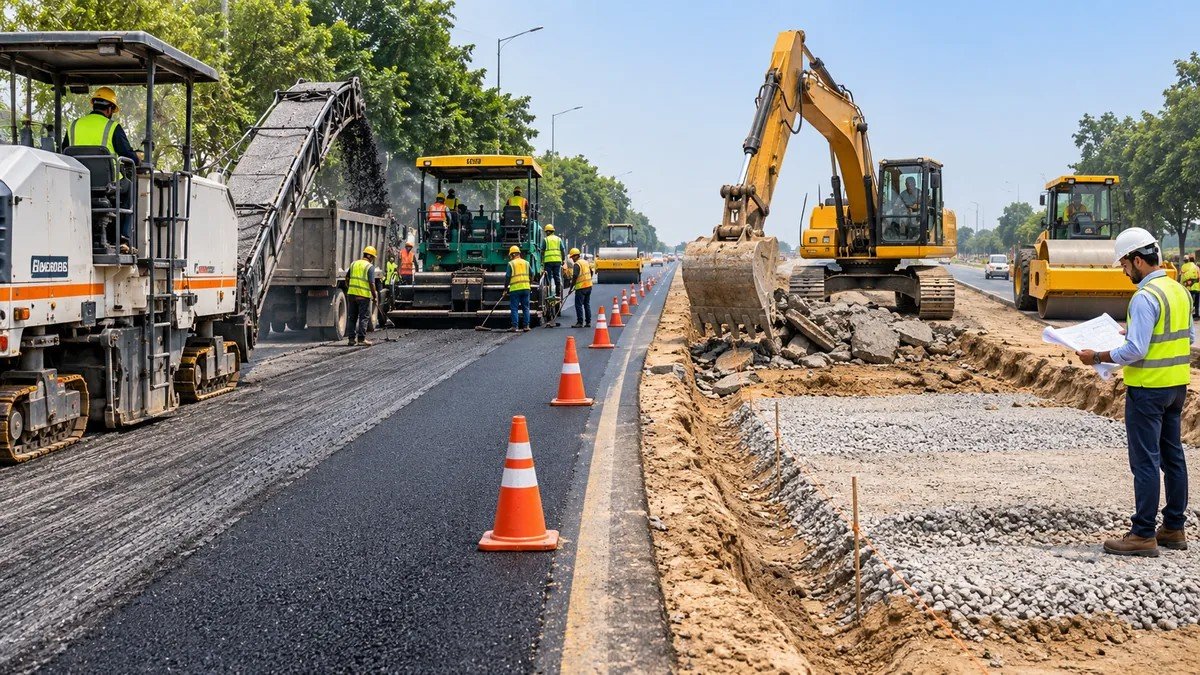
Road rehabilitation means treatments that restore or improve an existing road’s serviceability, safety, and sometimes structural capacity, while retaining suitable parts of its pavement structure. It can include asphalt milling and resurfacing, structural overlays, localized base repairs, crack sealing, pavement recycling, full-depth reclamation, shoulder strengthening, and drainage repairs.
A structural overlay should not be treated as a permanent solution to failing subgrade unless underlying defects are corrected. Rehabilitation is most suitable when distress is localized or moderate and investigations show retained layers can support intended traffic after treatment.
What Is Road Reconstruction?
Road reconstruction rebuilds pavement where existing components have deteriorated beyond an economical rehabilitation solution or substantial design changes are necessary. Activities can include removal of failed pavement; excavation and unsuitable-soil replacement; subgrade treatment; rebuilding subbase and base; new asphalt or concrete layers; drainage, shoulders, road markings, and testing.
Not every reconstruction project must replace all components along its entire length. Widespread structural failure, persistent settlement, severe rutting, inadequate pavement thickness, unsuitable foundation material, or changes in traffic or alignment can justify reconstruction, subject to engineering investigations.
Road Rehabilitation vs Reconstruction: Key Differences
| Factor | Rehabilitation | Reconstruction |
|---|---|---|
| Main objective | Restore and extend serviceability | Replace failed or inadequate pavement structure |
| Existing pavement | Retains serviceable components | Replaces unsuitable components |
| Initial investment | Usually lower | Usually higher |
| Construction duration | Often shorter | Often longer |
| Traffic disruption | Often more manageable | Often more extensive |
| Earthworks and materials | Generally limited | Can be substantial |
| Structural capacity | Depends on treatment design | Can provide comprehensive redesign |
| Best application | Repairable defects with serviceable layers | Extensive failures or major redesign |
These are tendencies, not universal rules: rehabilitation with widespread repairs and complex traffic management can approach reconstruction costs.
Which Is More Cost-Effective: Rehabilitation or Reconstruction?
The answer depends on initial construction cost and long-term pavement performance. Rehabilitation often uses fewer new materials and requires less demolition, but repeated repairs or early failure can erase the initial saving. Reconstructing a road that could be rehabilitated, meanwhile, wastes usable materials and budget.
Initial construction cost
Retaining suitable layers often makes rehabilitation cheaper, while reconstruction typically requires more earthworks, material, equipment, testing and construction time.
Expected service life
Reconstruction may deliver a longer period before major structural intervention when properly designed. Rehabilitation can also extend life substantially. There is no universal lifespan for either method; design, traffic, materials, drainage and workmanship are decisive.
Future maintenance and road-user costs
Allow for routine and periodic treatments, traffic delays, vehicle operating costs, work-zone disruption and safety. The cheapest construction bid may not represent the best public value.
Environmental and material considerations
Reusing suitable existing layers can reduce demolition waste and virgin-material demand. But transport, recycling operations, construction emissions, and long-term performance must be assessed as part of the whole-life picture.
Practical Cost Comparison: Rehabilitation vs Reconstruction
Consider a hypothetical 10-kilometre road with two technically feasible options. These amounts are illustrative assumptions, not current Pakistan market rates or a quotation.
| Cost element | Rehabilitation | Reconstruction |
|---|---|---|
| Initial works | PKR 180 million | PKR 350 million |
| Year 10 intervention | PKR 70 million | PKR 20 million |
| Year 20 intervention | PKR 110 million | PKR 50 million |
| Undiscounted total | PKR 360 million | PKR 420 million |
Applying life-cycle cost analysis
Assume a real discount rate of 5%, costs in constant purchasing-power terms, and a 20-year analysis period. The simplified calculation is present value = future cost ÷ (1 + discount rate)year.
Rehabilitation: PKR 180 million initially + approximately PKR 43.0 million (year 10) + PKR 41.5 million (year 20) = about PKR 264.5 million in present-value agency costs.
Reconstruction: PKR 350 million initially + approximately PKR 12.3 million (year 10) + PKR 18.8 million (year 20) = about PKR 381.2 million.
Under these assumptions rehabilitation is approximately PKR 116.7 million lower in discounted agency costs. This simplified comparison excludes road-user costs, residual value, uncertainty and potentially differing end-of-period condition. The result can change if deterioration accelerates, maintenance increases or traffic disruption differs. The lesson is to compare evidence, not assume that rehabilitation always wins.
For related pricing considerations, read Road Construction Cost in Pakistan.
How Engineers Decide Between Road Rehabilitation and Reconstruction
1. Conduct a pavement condition survey
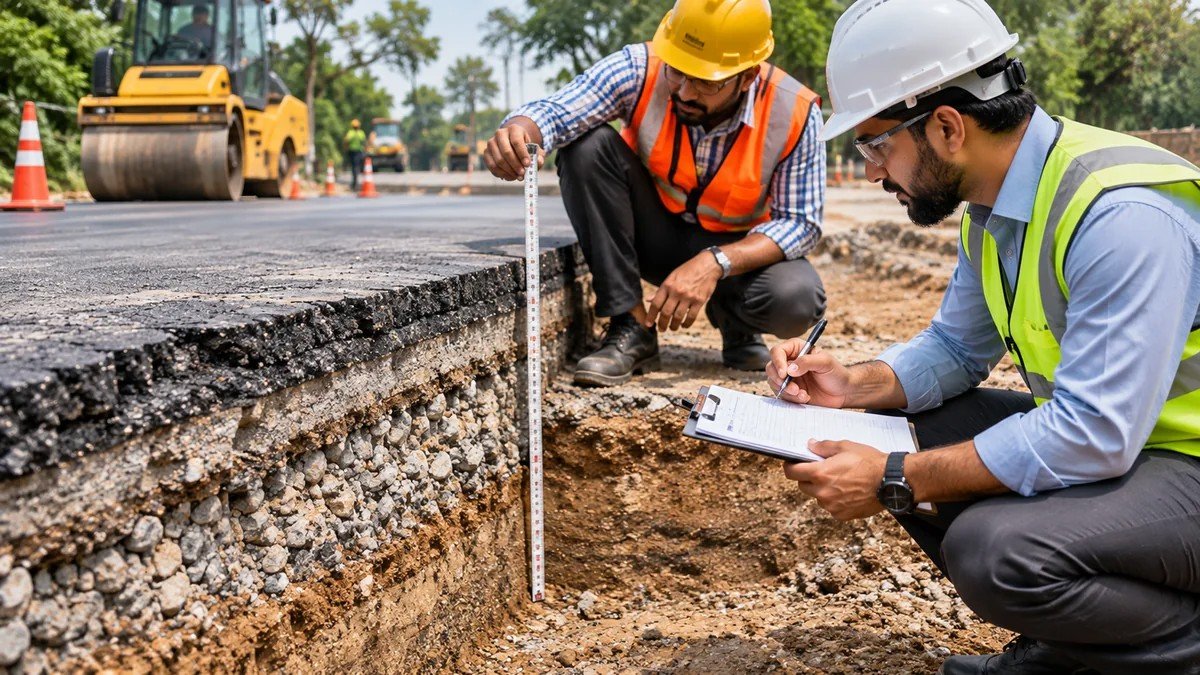
Inspect cracks, potholes, rutting, depressions, edge failures, surface roughness and drainage-related defects. Map both the extent and severity to distinguish surface distress from structural issues.
2. Evaluate structural capacity
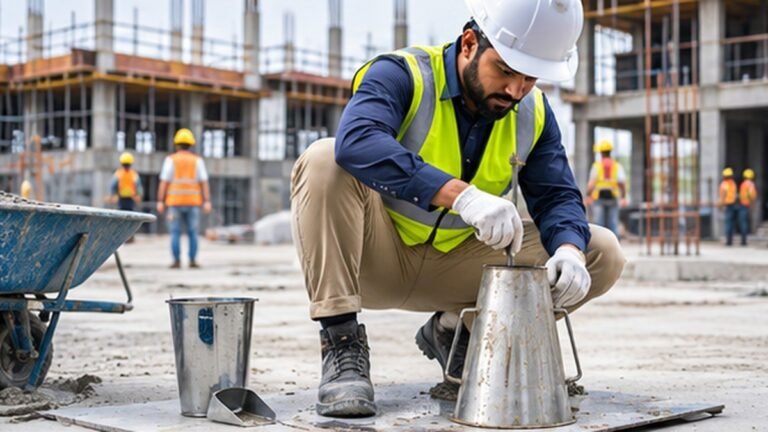
Depending on the project, use deflection testing, coring, trial pits, layer-thickness checks and pavement investigations to determine whether existing layers can support forecast loads.
3. Investigate the subgrade and drainage
Weak soils, standing water, blocked drains, poor crossfall and infiltration can undermine overlays. Correct the underlying cause before selecting a surface treatment.
4. Review present and future traffic
Consider heavy-commercial-vehicle loading, axle weights, traffic growth and the intended road function. A pavement designed for light traffic may need fundamental strengthening.
5. Develop feasible treatment alternatives
Compare overlays, local base replacement, deeper rehabilitation, full-depth reclamation and reconstruction where technically appropriate. Mixed treatment zones may be economical.
6. Prepare complete cost estimates
Measure each work item and include pavement layers, drainage, earthworks, equipment, materials, haulage, testing, safety and traffic management. Use local verified project rates and specifications, not generic per-kilometre figures.
7. Compare whole-life cost and uncertainty
Compare alternatives over the same analysis period and test different discount rates, service-life assumptions, costs, road-user impacts and residual values.
8. Select the preferred engineering solution
Account for safety, design standards, feasibility, funding, environmental effects and public disruption alongside the life-cycle cost result.
Road Rehabilitation Methods That Can Reduce Costs
Asphalt milling and resurfacing
Mill existing asphalt to the specified depth and place a new surface or overlay, where retained layers are adequate or can be strengthened.
Localized full-depth repair
Excavate and rebuild failed sections while retaining surrounding pavement that remains serviceable.
Pavement recycling
Process existing material for reuse under a designed system, potentially reducing disposal and demand for new aggregates.
Full-depth reclamation
Reprocess asphalt and selected underlying material to form a designed pavement layer. It requires sound material assessment, mix design and strength verification, and is not simply a surface repair.
A Colorado Department of Transportation study reported favourable economics for full-depth reclamation in its case studies. These results are context-specific and should not be directly applied to Pakistani projects without local assessment.
Road Rehabilitation and Reconstruction in Pakistan
Heavy commercial traffic
Repeated heavy axle loads contribute to rutting, fatigue and structural distress. Evaluate traffic demand and pavement thickness before resurfacing major freight routes.
Drainage and monsoon conditions
Water penetration, inadequate drainage and wet pavement foundations accelerate deterioration. Rehabilitation may require significant drainage improvement.
Variable pavement quality
Road sections may have different construction histories, repair quality and subgrade conditions. One treatment across an entire corridor may not be economical.
Funding and procurement
Clients must balance budgets with long-term performance. Federal public procurement requires attention to applicable PPRA standard bidding documents; other authorities may have distinct requirements. Support pricing with drawings, specifications and an accurate bill of quantities.
See Planning a Road Construction Project in Pakistan: 9 Key Steps for the wider preparation process.
Common Mistakes When Comparing Rehabilitation and Reconstruction
Choosing the lowest initial bid
Low upfront cost does not necessarily equal low whole-life cost. Compare technically suitable options over the same period.
Resurfacing over structural failure
New asphalt cannot correct serious underlying defects. Investigate strength and perform necessary deep repairs.
Ignoring drainage
Persistent water damage can cause new surfacing to fail prematurely. Include surface and subsurface drainage in the design.
Assuming unrealistic service life
Use documented evidence and sensitivity analysis rather than optimistic estimates of treatment durability.
Applying one treatment to every road section
Divide the road into condition-based zones and select suitable repairs for each.
Missing traffic-management costs
Traffic staging, closures and public disruption affect both contractor and user costs.
Preparing an incomplete BOQ
Missing drainage, testing, disposal, pavement layers or safety items distort the comparison. Cost complete scopes of work.
Road Rehabilitation vs Reconstruction: Decision Checklist
- Confirm observed pavement defects and root causes.
- Verify existing layers, subgrade and structural capacity.
- Assess drainage and traffic loading.
- Develop feasible alternative treatments by road section.
- Estimate complete initial and future costs.
- Include safety, disruption, feasibility and uncertainty.
- Compare whole-life outcomes and document the final decision.
Frequently Asked Questions
Is road rehabilitation cheaper than reconstruction?
Usually it has a lower initial cost because usable pavement remains. Whole-life cost depends on structural condition, future maintenance and traffic impacts.
What is the difference between resurfacing and reconstruction?
Resurfacing renews surface layers. Reconstruction rebuilds failed or inadequate pavement components, which may include base, subbase and subgrade treatment.
How long does road rehabilitation last?
No single lifespan applies. It depends on treatment, traffic loading, drainage, materials, construction quality and existing structural condition.
When should a road be reconstructed?
Consider reconstruction when widespread structural failure, foundation deficiencies or major design changes make rehabilitation unsuitable or uneconomical.
Can a badly damaged road be rehabilitated?
Sometimes, using deep rehabilitation, local reconstruction or full-depth reclamation. Engineering investigations must establish feasibility.
Does reconstruction always provide better value?
No. Reconstructing serviceable pavement can waste money and materials. Compare suitable options using whole-life costs.
How should rehabilitation cost be estimated in Pakistan?
Use project-specific measured quantities and verified rates for pavements, drainage, transport, labour, equipment, testing and traffic management.
Final Verdict: Which Road Treatment Offers Better Value?
Rehabilitation often offers better value when existing pavement can be economically restored. Reconstruction is justified when widespread structural failure or major design changes require a new pavement structure. For many roads, a mix of treatments across different sections is the most practical approach.
Effective road asset management means choosing the right treatment at the right time using reliable condition data and realistic future costs.
Planning a Road Rehabilitation or Reconstruction Project?
Techno TIME Construction Pvt Ltd provides road, highway, bridge and civil infrastructure construction services in Pakistan. Explore our Roads & Highways services and civil engineering expertise, or contact our team with the road location, pavement condition, drawings and intended scope.
Authoritative References
- FHWA: Life-Cycle Cost Analysis
- FHWA: Pavement Remaining Service Life and Rehabilitation
- PIARC: Whole-Life Cost
- PIARC: Lifecycle Planning
- Colorado DOT: Full-Depth Reclamation and Overlay Cost Comparison
- Pakistan PPRA: Standard Bidding Documents
Technical disclaimer: Pavement treatments, costs and life expectancy require project-specific investigation and professional engineering assessment. All cost figures above are illustrative, not current Pakistani quotations.